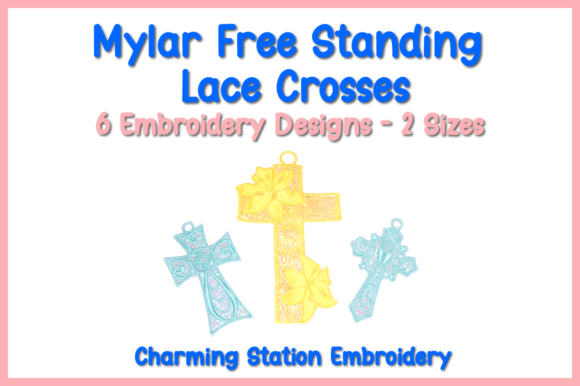
Mylar FSL Crosses: A Designer's Review for Holiday Projects
As an embroidery designer who spends countless hours digitizing and stitching out files for clients, I am always cautious about downloading new design assets. The market is flooded with generic patterns, but occasionally, a collection stands out for its specific utility and visual impact. Recently, I evaluated the Mylar FSL Crosses set from Creative Fabrica to determine if it would be a viable addition to my library for upcoming seasonal orders. This review breaks down the potential of these six Free Standing Lace designs for real-world commercial embroidery projects.
First Impressions and Visual Mood
The immediate appeal of the Mylar FSL Crosses lies in their intended finish. While many standard cross designs rely solely on thread density for texture, this set is explicitly engineered to incorporate a layer of Mylar. In the context of Religion and holiday Embroidery, sparkle is often a key selling point for customers looking for festive decor or meaningful gifts. The visual mood here is celebratory yet reverent. The lace structure suggests delicacy, while the potential for metallic sheen adds a premium feel that flat stitching cannot achieve. For a designer, this offers a unique opportunity to create a finished product that looks significantly more expensive than the cost of materials.
Practical Applications for Commercial Use
When considering where to deploy these designs, the versatility of Free Standing Lace (FSL) opens several doors for small business owners and Etsy sellers. Unlike applique or standard fill designs that require a base fabric, FSL creates a standalone object. Here is how I envision using these in a commercial setting:
- Seasonal Ornaments: The primary use case is obvious. These crosses make exquisite hanging decorations for Christmas trees or year-round wall art in nurseries and prayer rooms.
- Apparel Embellishments: While FSL is typically 3D, smaller versions from the set could be tacked onto a sweatshirt embroidery project as a raised patch, adding dimension to custom apparel.
- Tote Bag Accents: Stitching these onto a canvas tote bag design requires careful stabilization, but the result is a high-end boutique look that justifies a higher price point.
- Gift Toppers: Instead of a bow, these can serve as reusable gift toppers for baptism or confirmation gifts, enhancing the unboxing experience.
- Home Decor: Incorporating them into a pillow cover arrangement or adhering them to a wooden plaque creates instant nursery decor or sanctuary accents.
Technical Considerations and Stitching Performance
Working with FSL and Mylar requires a shift in technique compared to standard machine embroidery design workflows. The description notes that the samples were sewn with Mylar for extra sparkle but can be sewn without it. This flexibility is crucial. If you are stitching on a dark fabric where Mylar might not show well, or if the client prefers a matte finish, you have options. However, for maximum impact, the Mylar layer is essential.
There are specific technical challenges to anticipate. First, stitch density in lace designs must be balanced; too dense, and the lace becomes stiff and board-like; too open, and it lacks structural integrity. Before committing to a customer order, such as a batch of embroidered patches or holiday ornaments, it is vital to test on scrap fabric or water-soluble stabilizer. You need to ensure the lace holds its shape once the stabilizer is dissolved.
Furthermore, consider the hoop size. FSL designs often push the limits of standard hoops. Ensure your machine can accommodate the largest cross in the set. If you plan to place these on curved surfaces like a cap, remember that FSL is rigid once finished. It does not stretch with the fabric. Therefore, these are better suited as appliqués sewn onto the cap rather than direct stitching into the fabric structure, unless the design is very small.
Fabric and Thread Choices
The success of these designs heavily depends on your material choices. When using Mylar, thread colors play a supporting role. Metallic or variegated threads can enhance the sparkle, while matte cotton threads provide a nice contrast that lets the Mylar shine. For custom apparel or items that will face frequent washing, such as an apron or kitchen towel, you must secure the FSL element thoroughly. Zig-zag or satin stitch borders may be necessary to attach the lace securely to the base item to prevent peeling after multiple wash cycles.
If you are working with textured or stretchy fabrics, the stability of the FSL element can actually help reinforce the area, provided it is attached correctly. However, avoid placing large, rigid FSL crosses on areas of high flex, like the elbow of a sweatshirt, as this can cause discomfort and eventual detachment.
Enhancing Product Value and Brand Perception
In the competitive world of handmade goods, presentation is everything. Using Mylar FSL Crosses can significantly elevate buyer trust and perceived value. A simple embroidered cross is common; a shimmering, dimensional lace cross signals attention to detail and craftsmanship. This distinction is vital for commercial embroidery businesses aiming to stand out at craft fairs or in online boutiques.
From a marketing perspective, these designs offer excellent opportunities for printable mockups and product photography. The way light catches the Mylar layer creates dynamic images that perform well on social media, driving customer engagement. For those selling digital embroidery files, offering a tutorial on how to achieve the best Mylar results with this specific set could be a valuable bonus that builds brand loyalty.
Final Verdict and Licensing Notes
The Mylar FSL Crosses set is a specialized tool rather than a general-purpose library. It excels in creating focal points for holiday collections, religious events, and upscale home decor. The ability to toggle the Mylar effect gives the designer control over the final aesthetic, making it adaptable for various client preferences.
However, before integrating this into your production line, there are critical steps to take. Since specific file formats, exact stitch counts, and detailed license terms were not fully enumerated in the brief product description, you must confirm file details and licensing on the Creative Fabrica product page before selling finished items. Some licenses allow unlimited physical sales, while others may have restrictions. Additionally, verify the recommended stabilizer type—water-soluble is standard for FSL, but the weight matters.
For embroidery designers looking to add a touch of magic to their personalized gift offerings or expand their design assets with something that truly sparkles, this set is worth exploring. Just remember: test your tension, check your hoop capacity, and let the Mylar do the heavy lifting for visual appeal. With proper execution, these crosses can become a signature element of your seasonal portfolio.